

OpenAI has confirmed what many in the digital marketing world suspected was coming: ads are officially on the roadmap for ChatGPT. They’re not live yet. They’re being tested in the US only. And if you’re a paying user, you won’t see them at all, with the exception of the lower-priced ChatGPT Go tier, at least for now.
But make no mistake: this announcement is a meaningful shift in how digital discovery is evolving. And while New Zealand is rarely first to market for platform changes like this, history tells us we’re rarely far behind either.
What OpenAI Actually Announced
In its official statement, OpenAI laid out a relatively cautious approach to advertising inside ChatGPT.
Here’s what we know so far:
- Ads will initially be tested in the US only.
- They’ll appear for Free users and the ChatGPT Go tier.
- Paid tiers (Plus, Pro, Business, Enterprise, Education) will remain ad-free.
- Ads will be clearly labelled and shown after an AI response, not embedded within it.
- Advertisers will not influence ChatGPT’s answers.
- Sensitive topics like health, mental health, and politics are excluded
- Conversation data won’t be sold to advertisers.
- Some contextual or limited personalisation may be used, but users can opt out.
- Ads will only be shown to logged-in adult users and will not appear in sensitive topic areas.
In short, OpenAI is trying to introduce ads without breaking trust and without turning ChatGPT into another noisy feed. That alone tells us how seriously they’re taking the optics of this move.
Why OpenAI Is Doing This (And Why NZ Marketers Should Care)
Running AI at a global scale is expensive. Very expensive. Subscriptions help, but they don’t cover the cost of serving hundreds of millions of users, especially when most people use ChatGPT for free. Advertising offers a familiar solution: subsidise access without hard paywalls. As OpenAI notes in its announcement, “We want to expand access to ChatGPT while building a sustainable business that can support long-term innovation.”
From a platform-lifecycle perspective, this is textbook:
- Build something genuinely useful
- Scale adoption rapidly
- Introduce monetisation once behaviour is established
This is a familiar platform lifecycle; search did it, social did it, and AI will too. For NZ marketers, it signals the point where visibility stops being passive and starts becoming something you compete for.
Trust, Bias & the Line OpenAI Is Trying Not to Cross
OpenAI has been very deliberate in how it’s framed this move. The company has gone out of its way to emphasise that advertising won’t influence how ChatGPT responds, and that trust remains central to the product.
As OpenAI puts it in its announcement: “People trust ChatGPT for many important and personal tasks, so as we introduce ads, it’s crucial we preserve what makes ChatGPT valuable in the first place. That means you need to trust that ChatGPT’s responses are driven by what’s objectively useful, never by advertising.”
On paper, that distinction is clear. In practice, perception matters just as much as implementation. Introducing ads, even clearly labelled, carefully separated ones, inevitably puts pressure on that perception.
That’s why OpenAI is excluding sensitive topics, keeping ads visually distinct from responses, and limiting personalisation early on. The company is trying to monetise without undermining the very trust that made ChatGPT useful in the first place.
Any brand appearing in an AI-driven environment isn’t just buying visibility; it’s borrowing from the platform’s credibility. If that trust holds, the association can be powerful. If it erodes, brands risk being caught in the fallout.
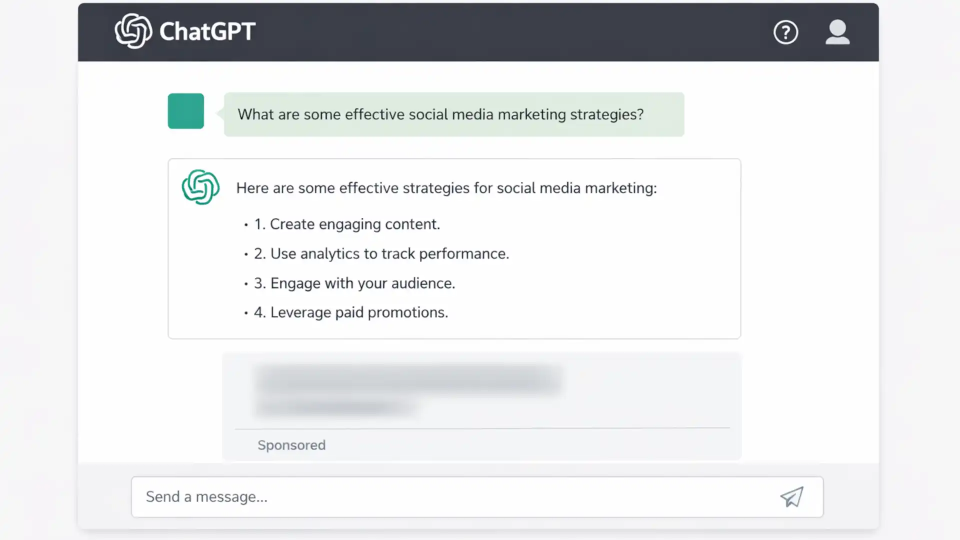
ChatGPT Ads vs Google Ads and Why This Isn’t “Search 2.0”
One of the biggest mistakes marketers can make right now is assuming ChatGPT ads will behave like Google Ads in a new wrapper. They won’t.
| Google Ads: | ChatGPT Ads: |
| Keyword-driven. Auction-based PPC. Shown alongside search results. Optimised for clicks and landing pages. | Triggered by semantic intent, not exact keywords. Shown after an answer, not before it. Framed more like a recommendation than an interruption. |
These distinctions matter because conversational AI isn’t just responding to queries; it’s helping users think. Ads that appear in that environment need to feel relevant, credible, and useful, or they’ll be ignored (or worse, distrusted).
This dynamic could be an advantage. Strong positioning and clear messaging may carry more weight than budget alone, giving smaller brands a better chance to compete.
This is More Than an Update, It’s a Directional Shift
OpenAI’s decision to introduce ads into ChatGPT is a clear signal that the platform is entering a new phase, one where scale, access, and monetisation start to converge. While testing is limited to the US for now, the direction is set.
For New Zealand businesses and marketers, this isn’t a call to act immediately. It’s a signal to pay attention. As AI platforms evolve from tools into discovery environments, the rules around visibility, credibility, and commercial presence will shift with them.