


For more than a decade, SEO felt predictable.
You identified a keyword.
You created a page targeting that keyword.
You optimised headings, adjusted density, built links, and, if you did it well, you ranked.
That system made sense because search engines were primarily matching strings. If your page contained the right phrases, structured in the right way, you were considered relevant. SEO became a discipline of precision targeting; one keyword, one page, one ranking goal.
But that’s not how modern search works anymore. AI-driven search systems don’t retrieve pages because they match a phrase. They retrieve content because it demonstrates understanding. They evaluate meaning, relationships, and context. They interpret intent. They synthesise answers. And yet, many SEO strategies still begin the same way they did ten years ago: with a spreadsheet of keywords.
If your SEO strategy is still built on isolated keyword targeting, you may still see rankings, but rankings are no longer the point. Search systems aren’t asking, “Did this page include the phrase?” They’re asking, “Does this source understand the concept?”
AI Search Has Changed the Unit of Relevance
The most important change in modern SEO isn’t a new feature or interface. It’s a shift in how relevance itself is determined.
For years, the unit of relevance was the keyword. AI-driven search has turned the tables, placing emphasis on the concept. That sounds like a subtle difference. It isn’t. It fundamentally changes what search engines reward, and what brands must build.
Search Now Retrieves Meaning, Not Wording
Modern search systems use semantic models that interpret ideas rather than just terms. Queries and content are mapped into representations of meaning, allowing engines to evaluate conceptual similarity instead of literal phrasing.
This shift is why paraphrasing doesn’t hurt relevance. It’s why repeating a keyword doesn’t strengthen authority. And it’s why “optimisation tricks” feel increasingly ineffective.
The system is no longer asking:
Did this page include the phrase?
It’s asking:
Does this content demonstrate real understanding of the idea behind the query?
And that’s a much higher bar for brands to reach. Mechanical optimisation can be engineered. Conceptual clarity cannot. You can tweak wording. You cannot fake depth.
Intent Is Interpreted, Not Declared
AI systems don’t simply respond to the words typed into the search bar. They infer what the user actually wants. The question isn’t just “what was typed,” but “what outcome is this person seeking?” Search engines model that intent and evaluate whether your content satisfies it, even if the wording doesn’t perfectly align.
This means ranking for a specific term is no longer the be-all and end-all. If your content does not align with inferred intent, visibility can evaporate even when rankings appear stable.

Context Is Now a Signal of Authority
Here’s where it becomes uncomfortable for many brands: authority is no longer page-level. AI search evaluates topical ecosystems, looking for reinforcing signals across related content. They assess whether your site demonstrates depth within a conceptual domain, not just presence across many loosely connected keywords.
If your content reads like a collection of disconnected keyword plays, it signals optimisation, not expertise. Authority today is measured at an ecosystem level. And that requires thinking about content strategy in terms of GEO, not traditional SEO, an approach rooted in knowledge architecture rather than keyword targeting.
Why Keyword-First Content Is Quietly Failing
Many brands aren’t experiencing a dramatic collapse in rankings. Instead, they’re seeing something more subtle and revealing: rankings without traffic, traffic without conversions, and content output increasing while impact declines. On the surface, activity looks strong. Underneath, returns are shrinking.
That’s not an algorithm glitch. It’s a structural mismatch.
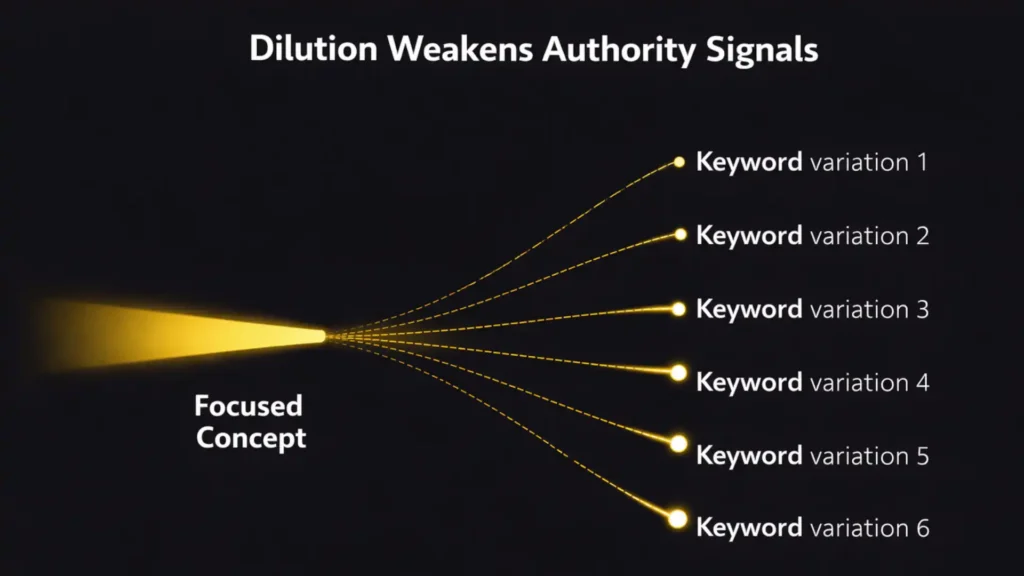
Keyword-first strategies optimise for visibility at the page level. AI-driven systems evaluate credibility at the topic level. When dozens of pages target slight variations of the same phrase, the result isn’t dominance, it’s dilution. Instead of strengthening authority, near-duplicate content splits signals. Instead of deepening expertise, thin AI-generated posts inflate volume. And when every competitor is scaling content at speed, volume stops being a differentiator.
Search engines are no longer impressed by coverage count. They’re evaluating conceptual command. That’s why keyword-first strategies aren’t collapsing overnight; they’re eroding slowly, delivering diminishing returns in a system that now rewards coherence over output.
The New Model: Concept-Driven SEO
If keyword-first SEO is delivering diminishing returns, the solution isn’t to optimise harder; it’s to rethink the model entirely. AI-driven search demands a shift from chasing phrases to building conceptual authority. This approach is the point where SEO moves beyond content output and becomes something more strategic.
Start with Concept Ownership
Most SEO strategies begin with the question: What keywords should we rank for? The better question is: What conceptual territory do we want to own?
There’s a meaningful difference between targeting “best payroll software” and positioning your brand around “payroll compliance for multi-entity businesses.” The first is a phrase. The second is a domain of authority. One can be optimised for; the other must be understood, explained, and reinforced.
Concept ownership forces clarity. It requires defining the problems you solve, the audiences you specialise in, and the ideas you want your brand to be associated with. It moves SEO upstream, from tactical targeting to strategic positioning.
Design for Contextual Reinforcement
Concept-driven SEO also requires your content to be architected. That means designing for:
- Strong internal linking that signals relationships between core and supporting topics.
- Clear taxonomy that defines how themes are structured across the site.
- Consistent terminology that strengthens semantic clarity.
- Structured, extractable explanations that make it easier for search systems to interpret and reference your content.
Your website should read like a knowledge system, where each page supports and strengthens the others. In an AI-driven search environment, coherence is a competitive advantage.
Build Depth, Not Variations
Once a core concept is defined, it’s time to build depth. That means exploring the topic through clear definitions, strategic implications, comparisons, risks, case scenarios, and implementation considerations. Each piece should strengthen overall understanding rather than compete with adjacent pages for similar phrasing.
Search systems aren’t counting related phrases. They’re evaluating whether you demonstrate command of the topic.

Authority in the Age of AI Search
AI-driven search environments synthesise content, generate answers, and increasingly, deliver visibility without requiring a click. That alone changes the competitive dynamic.
When search engines summarise, compare, and explain on behalf of users, they draw from sources that demonstrate clarity, coherence, and authority. Being indexed isn’t enough. Being mentioned isn’t enough. To surface meaningfully, your content must be structurally sound and intellectually credible.
Authority in this environment requires:
- Topical clarity: a clearly defined area of expertise.
- Depth: comprehensive coverage that signals genuine understanding.
- Structured reasoning: explanations that are logical, extractable, and well-argued.
- Original insight: perspectives, frameworks, or data that add something new.
In this environment, visibility follows credibility. The brands that win won’t just rank; they’ll be trusted enough to be referenced.
The Strategic Shift Brands Must Make
At this point, the implication is clear: this isn’t a minor adjustment to your content calendar. It’s a strategic shift in how SEO is conceived, resourced, and measured.
Many brands are still operating on legacy assumptions. They’re optimising harder inside a model that’s quietly losing relevance. That means some things need to stop. Brands need to stop chasing isolated keywords, publishing shallow AI-generated posts at scale, and measuring success purely by rankings. Those tactics optimise for activity, not authority.
SEO isn’t dying, but it is becoming harder.
The brands that win in AI-driven search will think in concepts, build topical ecosystems, demonstrate real understanding, and treat SEO as authority architecture, not keyword manipulation.
If you’re ready to move beyond keyword chasing and build a strategy designed for how modern search actually works, The Optimisers can help you design it properly.