

I’m obsessed with understanding and analysing the latest information about SEO / GEO and Agentic. When the latest State of Search report came out recently I blocked an entire afternoon to read, analyse and compare it with our own proprietary data.
Built on the Clickstream data the report analyses millions of desktop sessions and is published by Semrush with commentary from my friend, Rand Fishkin. Covering July 2025 – September 2026 across the US and 32 European countries, the data is very insightful on its own, but I try and incorporate an Asia Pacific lens over it.
Summary
AI tools reached 1.29% of desktop activity in the US, a 79% increase from the previous year (0.72%) with Europe rising to 1.42% (from 0.86%). What is really interesting is that traditional search still maintained between 9.47% and 10.02% of US desktop activity. These numbers are somewhat in-line with what we are seeing in our own data across Australia and New Zealand, and like the US and Europe the fastest growing aspect of search is still greater than 7x smaller than traditional search (Caveat: AI Overview is not delineated). Rand’s view is that it will take approximately 3-5 years before AI usage is even similar in size to the 2.98% of US desktop activity that comes from e-commerce.
I actually take a more bullish view than Rand, I think the rapid uptake of agentic AI agents such as Meta Muse, GPT Dots and Grok Bot will accelerate this by 12-18 months. Only time will tell!
Google’s difficult summer (our winter)
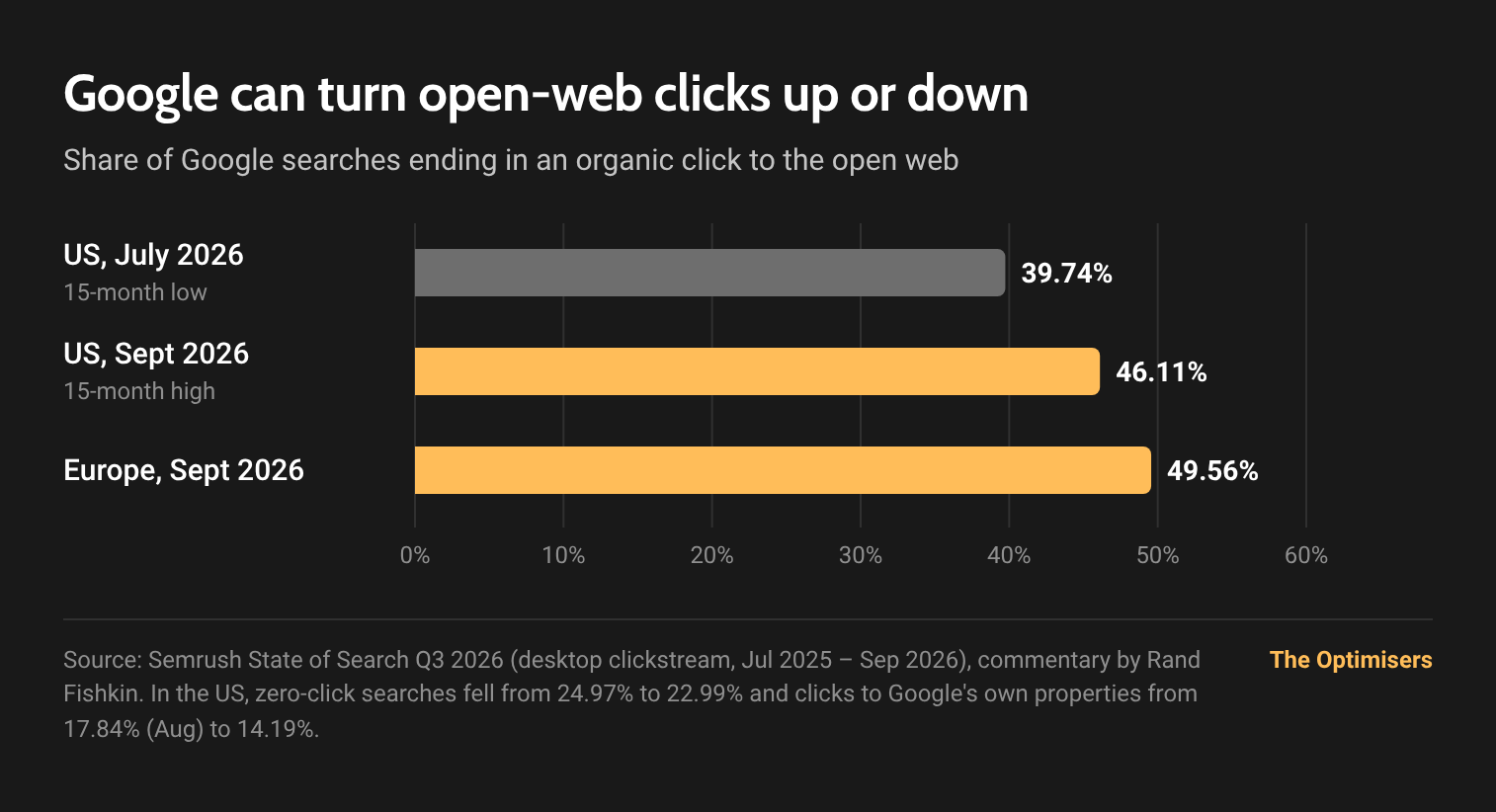
The share of US Google searches ending in an organic click to the open web fell to a new low of 39.74% in July. September saw a recovery to 46.11% which was the highest recorded in the 15 months of data. Zero click searches fell from 24.97% to 22.99% with clicks to Google’s own properties falling from 17.84% in August to 14.19%. Europe followed the same path, with organic click share reaching 49.56% in September.
Two other noteworthy things happened alongside that recovery. Searches per Google searcher in the US jumped from 94.90/103.03 (range) to 123.36 in July, with Rand pointing to a penalty on “back button hijacking”, agentic shopping features that fire multiple searches at once, and AI Overviews now on more than 50% of results. And Google’s share of desktop searches fell to 87.38% in August before jumping back to 92.43% in September. Interestingly Bing spiked to 7.76% that month with Rand attributing that to a Windows 11 experiment using pre-installed software like the Bing Wallpaper app (I didn’t even know that existed!) to move accidental clicks to Bing (It did not last!).
The lesson I take from this is that Google has the ability to dial up or down traffic to the open web whenever it chooses. This is why Search Everywhere Optimisation is so critical. Don’t put all your eggs in one basket!
Searchers are now typing longer searches
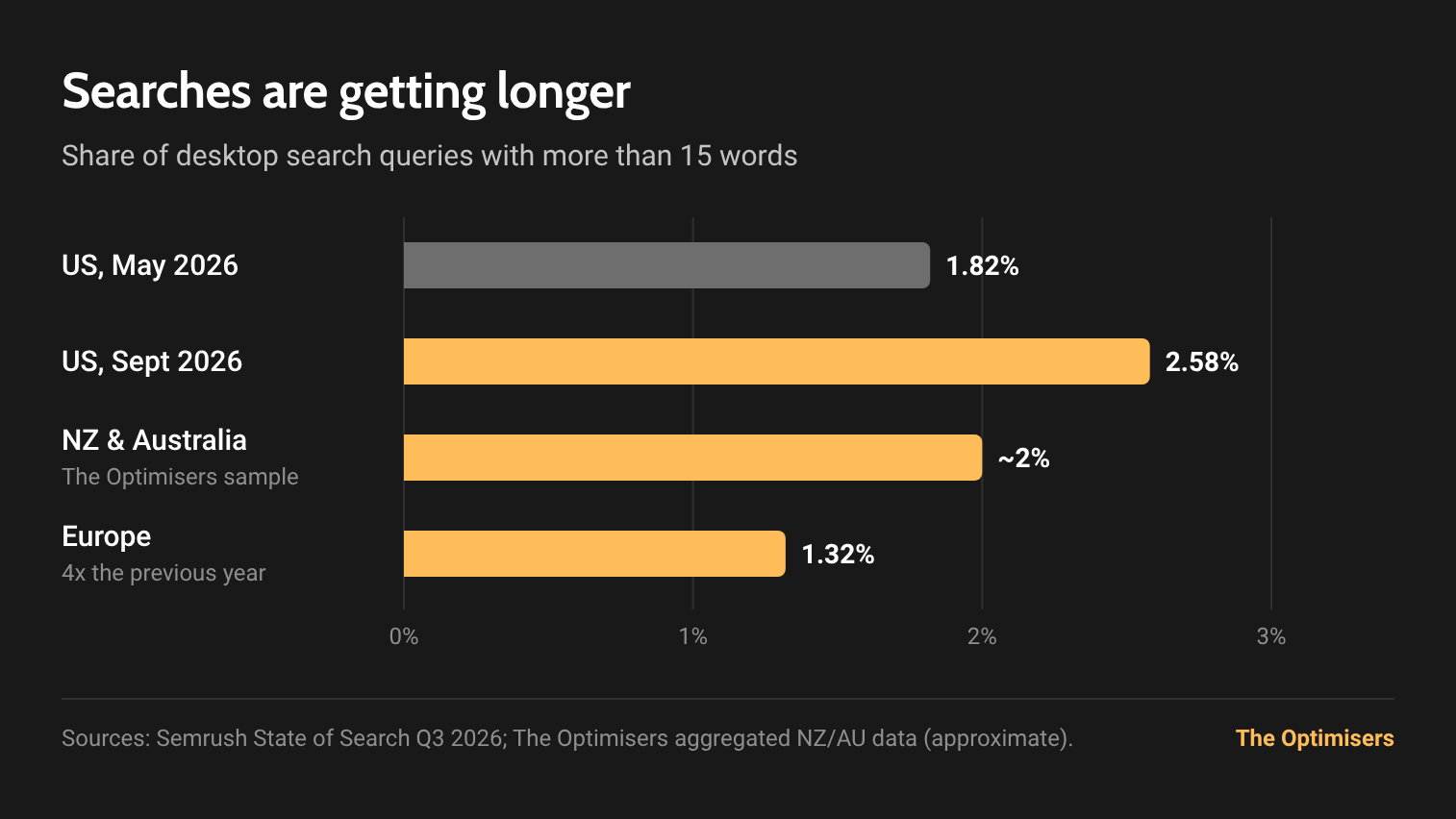
Searches of more than 15 words rose to 2.58% (from 1.82% in May) of desktop search queries in September in the US. In our aggregated sample set in New Zealand and Australia we are seeing closer to 2% (slightly increased from previous measurements).
In Europe they quadrupled their share from the previous year reaching 1.32%. Rand suggests that this could be because people are using Google much like an AI assistant as it produces similar outcomes.
Across the five engines tracked in the US, direct purchase intent queries were under 1.5% of searches with informational queries making up 64.03% of Google searches. The search box is evolving to a question box, optimising for a 2 word keyword is starting to look dated and is becoming invisible to a 16 word query.
AI league tables
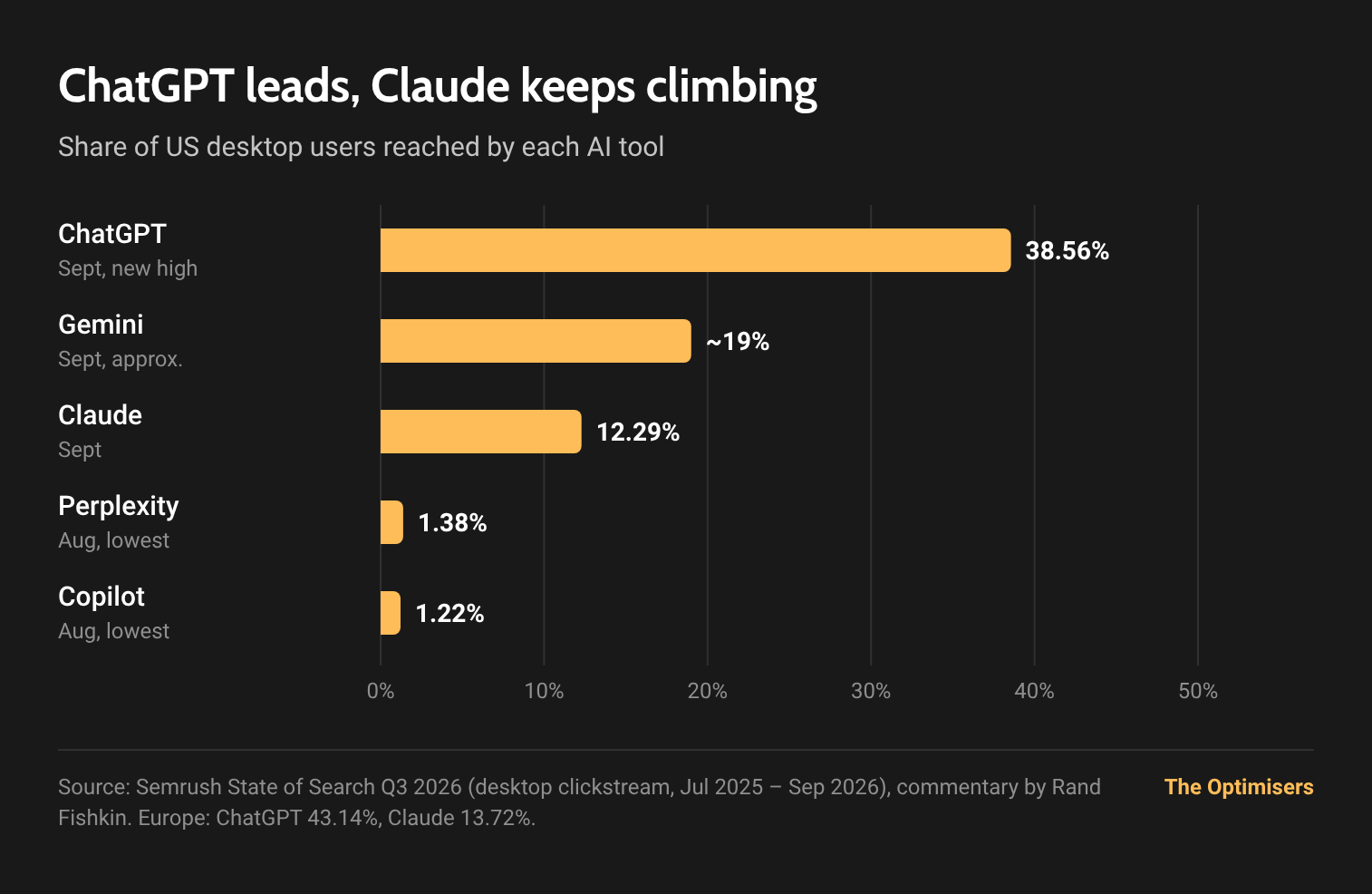
ChatGPT achieved a new high of 38.56% of desktop users in the US in September with 43.14% in Europe. Gemini made little progress at around 19% in the US. Claude continued its ascent, to 12.29% of US users and a European high of 13.72%. Unsurprisingly Perplexity and Copilot got their lowest US audiences in August, at 1.38% and 1.22% respectively. Google AI Mode more than doubled during the quarter, from 0.15% to 0.31% of US desktop activity. Rand’s warning is something to take note of: Google could make that line “take off like a rocket” by switching AI Mode on by default (currently it is opt-in). Interestingly, the top two places people visit after using an AI tool are Google and YouTube. The assistant is just one step in the user journey.
The New Zealand lens
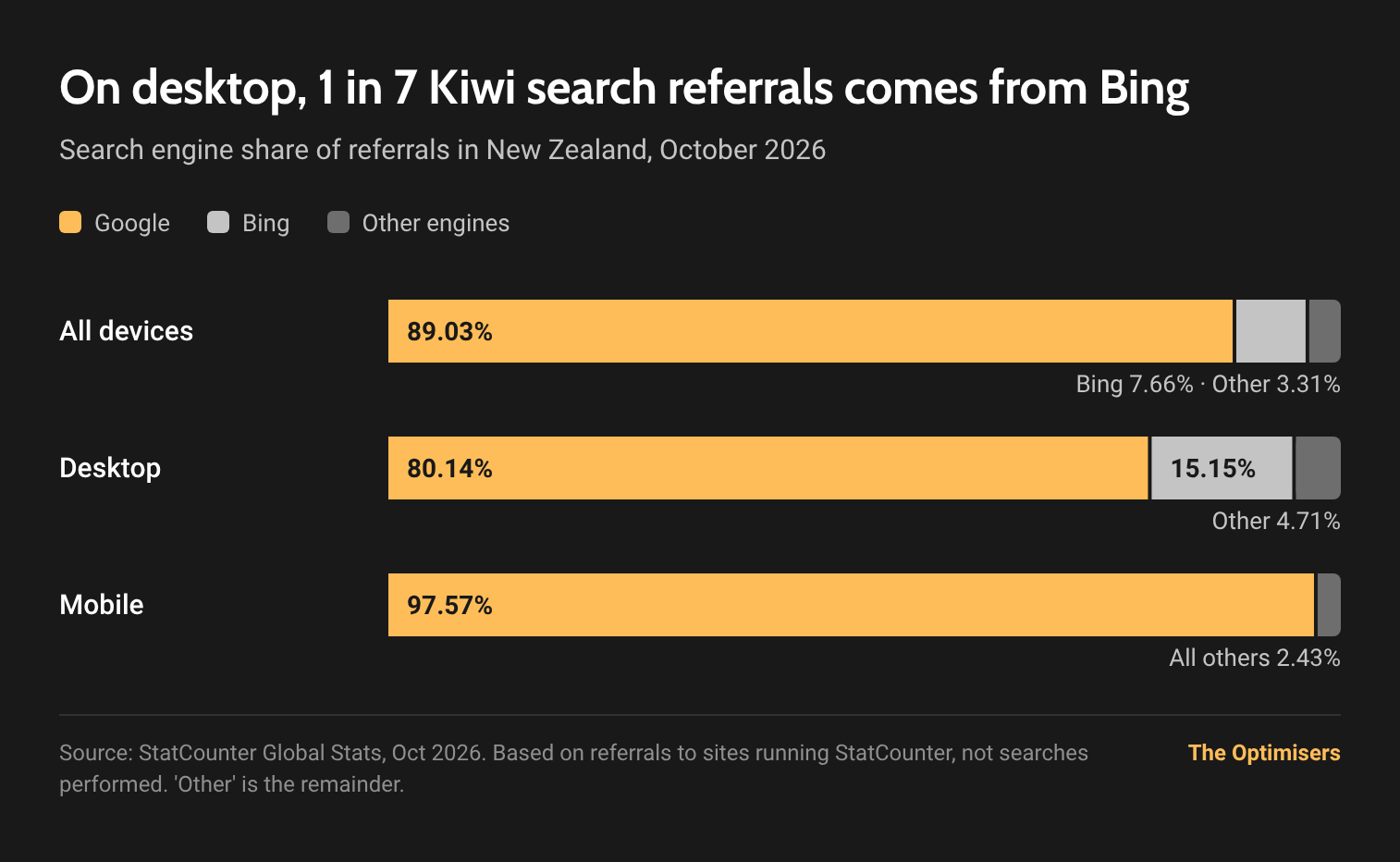
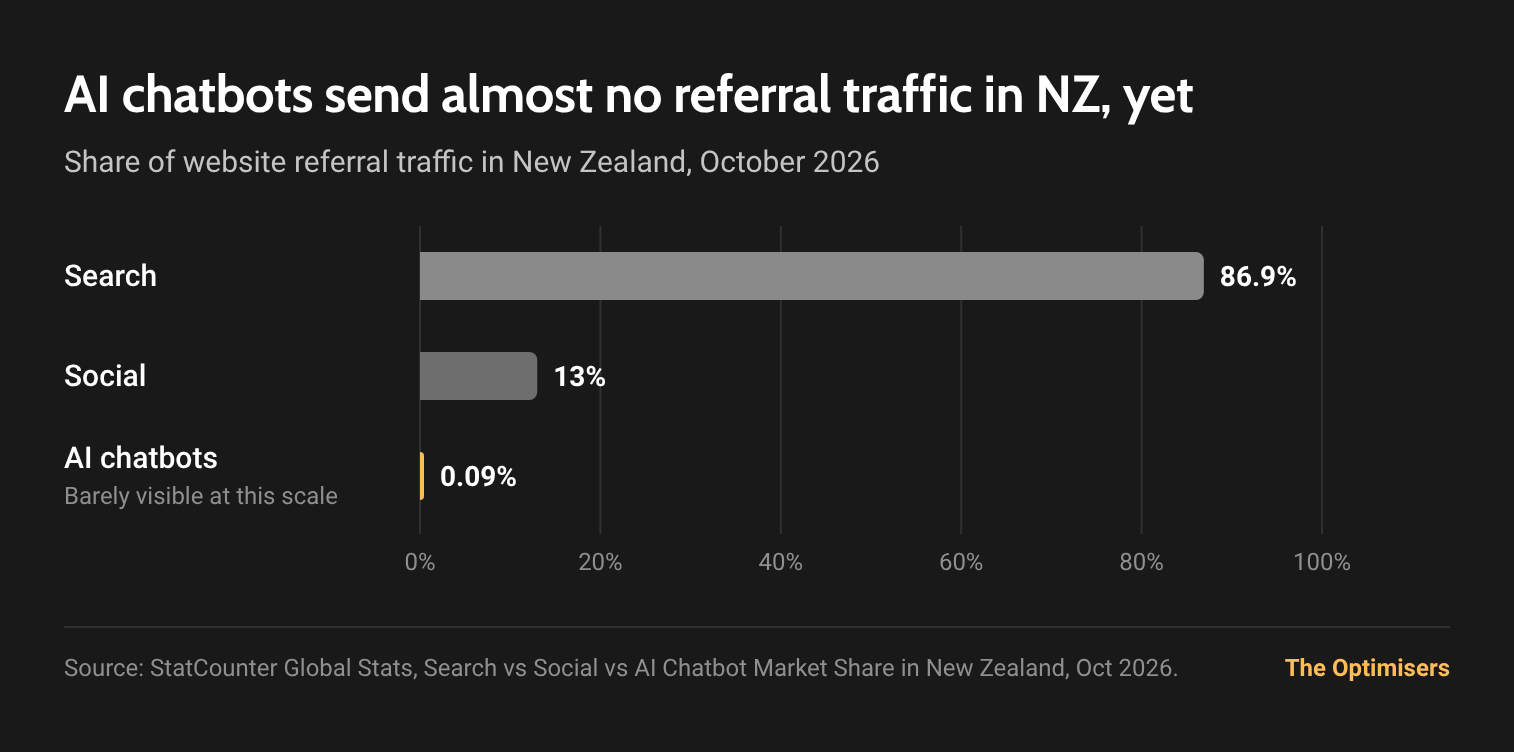
According to StatCounter’s October 2026 figures Google is sitting at 89.03% of New Zealand search engine referrals across all devices. Bing is at 7.66%. The desktop picture is different: Google 80.14% and Bing 15.15%. On mobile Google sits at 97.57%. Roughly one in seven Kiwi desktop search referrals comes from Bing, and very few companies I speak with have created a Bing Webmaster Tools account. StatCounter also tracks where website visits come from, and in October AI chatbots accounted for 0.09% of the New Zealand referral traffic it measures, against 86.9% from search and 13% from social.
In September OpenAI told 1News that New Zealanders now send almost 10 million messages a day to ChatGPT, 40% of respondents are using ChatGPT daily and that weekly active users here grew by over 20% in a year.
Whilst those numbers came directly from OpenAI (which therefore must be taken with a pinch of salt), even if you discount their claims somewhat, Kiwis are a population that uses AI a lot and often stay within the ecosystem rather than clicking out. Therefore, featuring your business in AI is critical and is likely to only increase in importance as use becomes more ubiquitous.
Our own proprietary report, with fieldwork in July and published in August, was very revealing. Seventy-six New Zealanders put the same questions to ChatGPT, Google AI Mode and Copilot on their own accounts with 888 answers provided. Electric Kiwi was mentioned in 97% of power answers and named first in 25%. Meridian was mentioned in 70% and named first in 1%. Canstar was used as a source in 66% of the power answers.
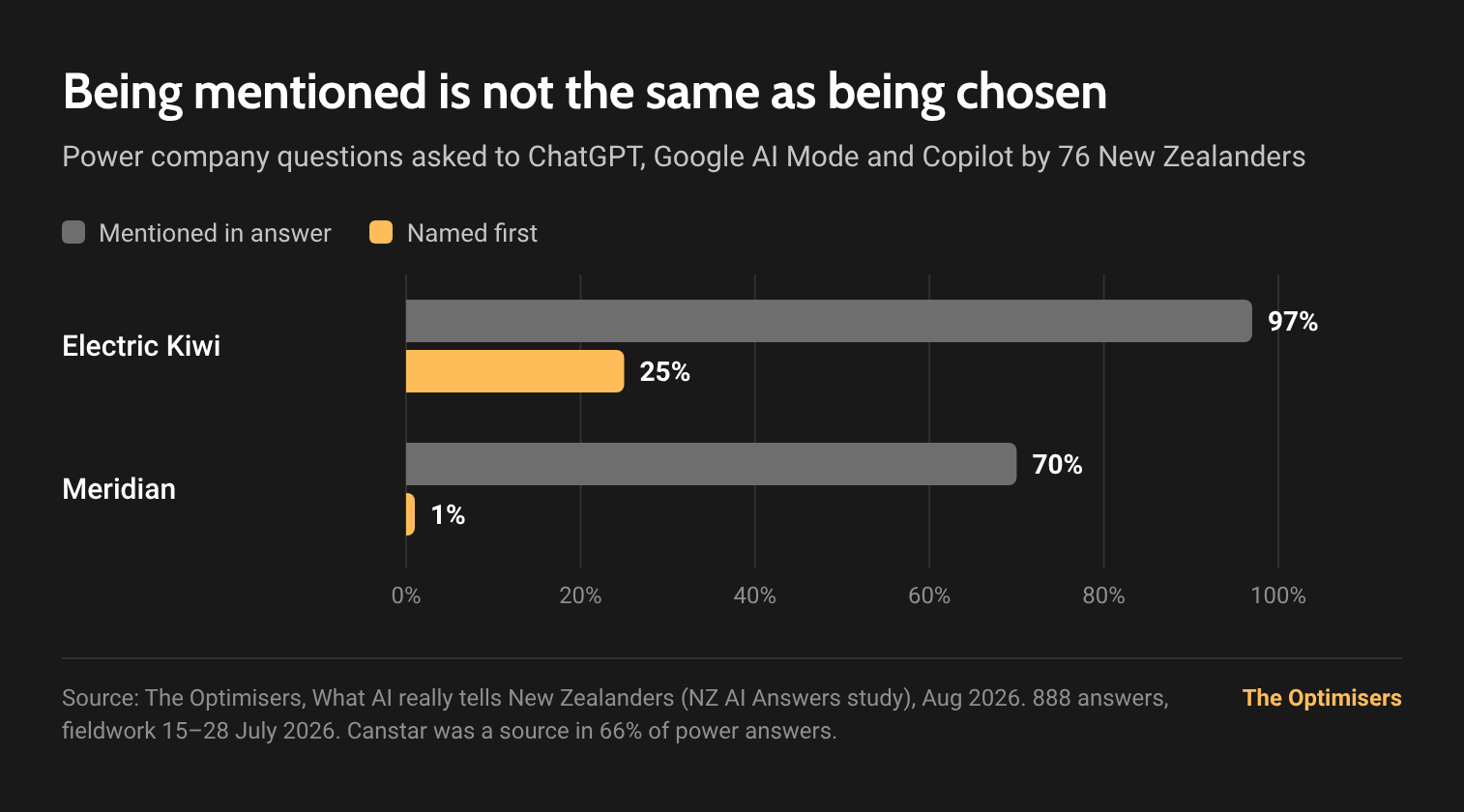
There is one big thing to watch, which I have seen many agencies be opaque about. Being talked about and being chosen are different value propositions. Most AI visibility tools and agencies measure the wrong metrics, who cares if you are mentioned but never recommended. Combine that with the trust backdrop: only 34% of New Zealanders say they are willing to trust AI, and New Zealand and Australia rank lowest of 47 countries on high acceptance of it. In our market, sceptical consumers that use the tools are exactly the audience that also checks the recommendation on Google, on Reddit and on a review site before taking action.
Search Everywhere, in Rand’s words
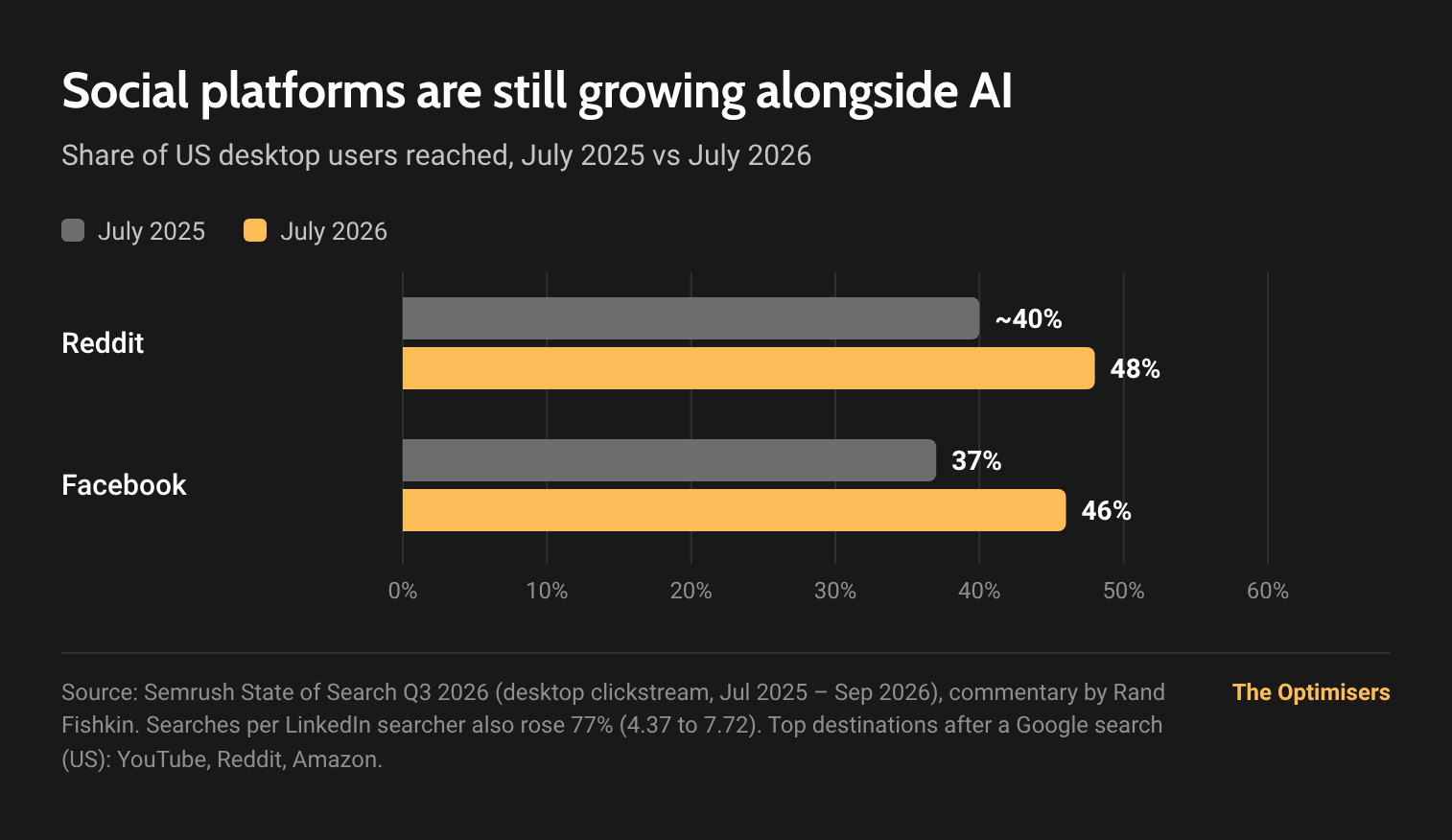
After a Google search, the top three destinations in the US were YouTube, Reddit and Amazon. In Europe YouTube, Reddit and Facebook took the top spots, with ChatGPT being seventh in both markets. Reddit’s reach among US desktop users rose from around 40% in July 2025 to 48% in July 2026, Facebook from 37% to 46%, and searches per LinkedIn searcher climbed 77%, from 4.37 to 7.72. Rand refers to “Search Everywhere” by name and concludes that generative AI shows almost no cannibalising effect on the big social platforms. I have been calling it Search Everywhere Optimisation for a while now, which is what I think best describes our discipline in 2026 and beyond.
On agentic commerce, Fishkin notes the e-commerce numbers show no sign of agents taking share yet. That squares with what I wrote last month about Meta’s Muse and OpenAI’s Dots. Nobody in New Zealand is losing a sale to an agent this week. The reason to prepare is that the data turns after the behaviour does, never before.
What to audit, build and measure
Audit
Pull your top 50 money queries from Search Console and count how many have become questions of ten words or more. Open Bing Webmaster Tools and find out what share of your desktop search traffic Bing is sending. Check whether you appear in AI Overviews and AI Mode for critical queries and that the answer accurately reflects what you want it to.
Build
Write answer content based on the data: use a question as the heading, a direct answer in the first paragraph, then the price, the exceptions and the comparison. Publish authentic contributions on YouTube, Reddit and LinkedIn, to capture the next step on people’s search journey. Third party proof is critical, find out where your industry citations come from and create a strategy for getting appropriate placements.
Measure
Track share of recommendations above share of mention. Track a small number of prompts with a higher frequency (provides precision, accuracy unfortunately is out of reach due to the probabilistic nature of LLMs and the parameters around how we use them). Watch branded search volume as often this is where we see AI answers starting. Look at organic click share in Search Console, because as we have established Google has shown it can move that number whenever it chooses. And add AI referrals as a line in your analytics, being aware that it will not be a big number at the start!
AI is the fastest growing thing in search whilst Google is still the largest. Search Everywhere Optimisation covers both and more. The future is coming fast… exciting times.
Sources
- Semrush, “State of Search Q3 2026: Behaviors, Trends, and Clicks Across the USA & Europe”, published under Semrush Data with commentary from Rand Fishkin, SparkToro. Desktop activity, US and 32 European countries including the UK, July 2025 to September 2026. No New Zealand or Australian data. https://enterprise.semrush.com/resources/state-of-search-q3-2026/
- Danny Goodwin, Search Engine Land, “Google organic click share reaches 15-month high: Report”, 4 November 2026 (Search Engine Land is owned by Semrush). https://searchengineland.com/google-organic-click-share-15-month-high-report-500595
- StatCounter Global Stats, “Search Engine Market Share in New Zealand”, October 2026, all platforms, desktop and mobile. Based on search engine referrals to the more than one million sites running StatCounter code, not on searches performed. https://gs.statcounter.com/search-engine-market-share/all/new-zealand and https://gs.statcounter.com/search-engine-market-share/desktop/new-zealand
- StatCounter Global Stats, “Search vs Social vs AI Chatbot Market Share in New Zealand”, October 2026. Referral traffic share. https://gs.statcounter.com/search-vs-social-vs-ai-chatbot-market-share/all/new-zealand
- Claudia Toxopeus, 1News, “Kiwis send 10 million ChatGPT messages a day as work use climbs”, 4 September 2026. OpenAI’s own usage data and an OpenAI commissioned survey; sample size not published. https://www.1news.co.nz/2026/09/04/kiwis-send-10-million-chatgpt-messages-a-day-as-work-use-climbs/
- The Optimisers, “What AI really tells New Zealanders”, the NZ AI Answers study, published August 2026. 76 participants, 888 AI answers, three engines, fieldwork 15 to 28 July 2026, methodology annex published. https://theoptimisers.com/nz-ai-answers-project/
- Gillespie, Lockey, Ward, Macdade and Hassed, “Trust, attitudes and use of artificial intelligence: A global study 2025”, University of Melbourne and KPMG. 48,340 respondents across 47 countries; New Zealand insights sheet published by KPMG New Zealand.