
The real revolution in SEO is Search Everywhere Optimisation
Since the inception of our first digital agency in 2009, SEO gave marketing leaders a tidy mental model. Win the Google ranking and you win the customer. Whilst that was never the full picture as it was contingent on the product, service or type of business you had, in 2009-2012 we would get regular calls from clients saying they were getting too many leads via Google alone. In 2026 this is no longer the case, audiences are fragmented, and AI is changing the game.
That model has evolved significantly and no longer encompasses the way people discover, compare and choose. Search has not died. It has metamorphosed from the search box to a plethora of different platforms.
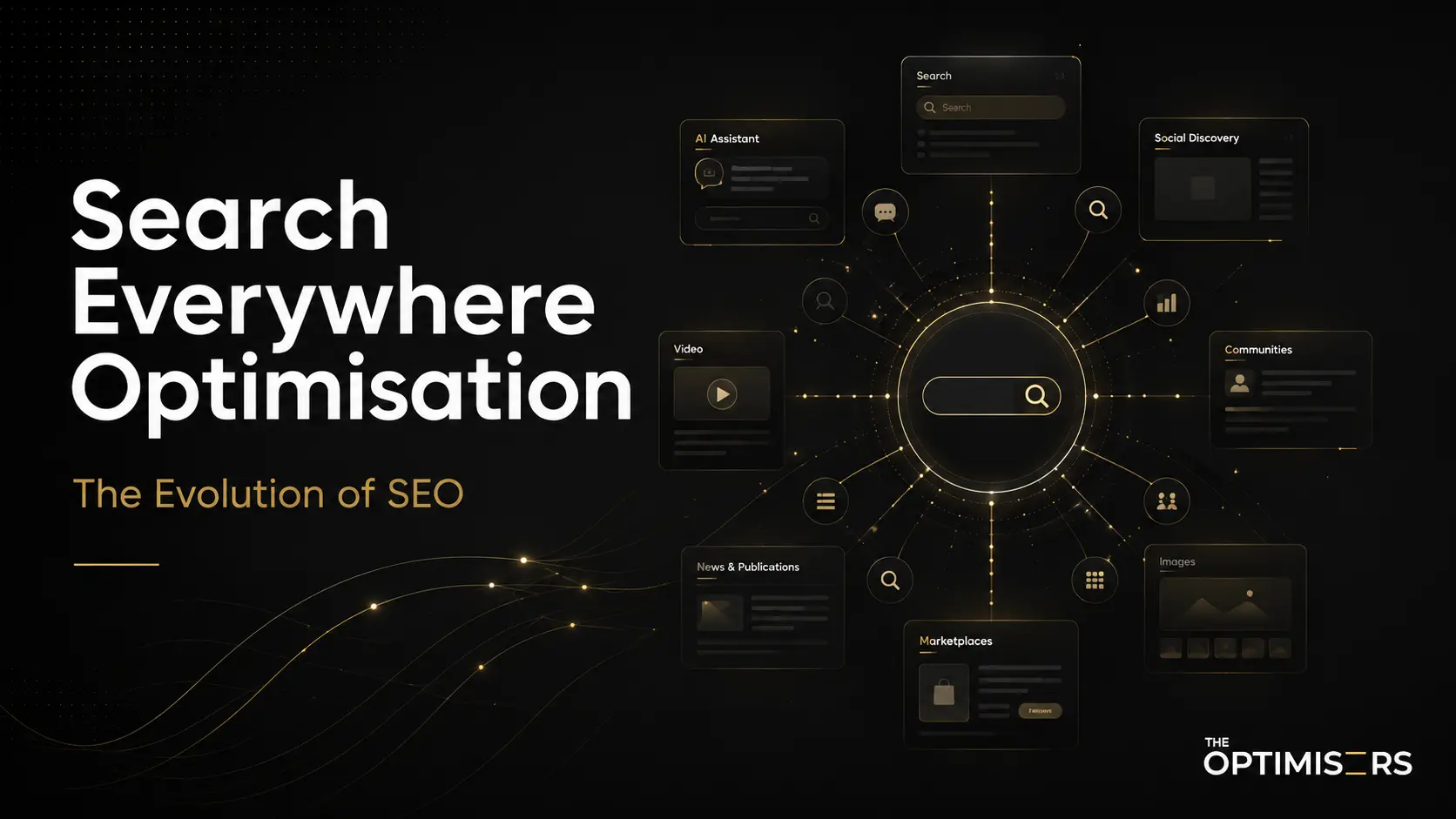
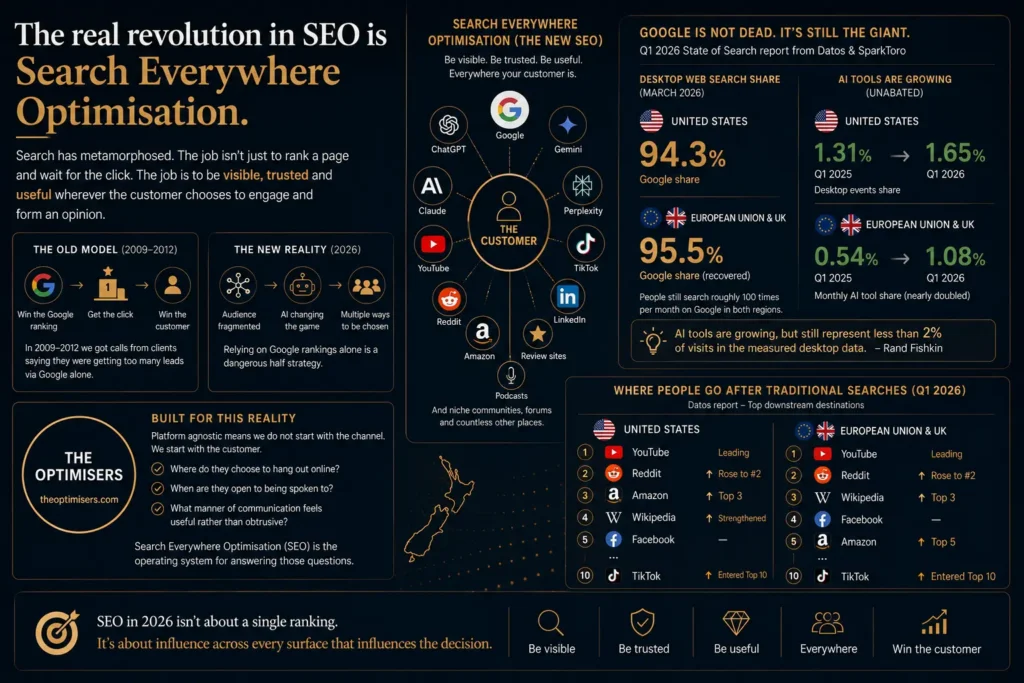
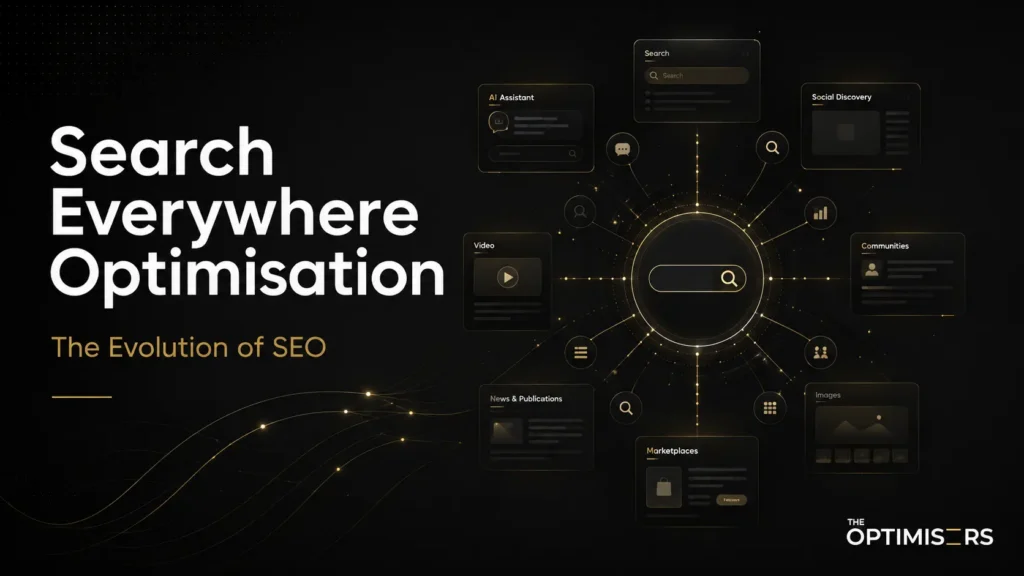
The real revolution in SEO is not simply AI search. It is Search Everywhere Optimisation (the new SEO!). The job isn’t just to rank a page and wait for the click. The job is to be visible, trusted and useful wherever the customer chooses to engage and form an opinion. It could be Google, ChatGPT, Gemini, Claude, Perplexity, YouTube, TikTok, Reddit, LinkedIn, Amazon, review sites, podcasts or a niche community forum.
In 2026 relying on Google organic rankings to carry brand visibility into AI is a dangerous half strategy. Google rankings still matter (a lot). They often feed the signals that AI systems see (although recent data suggests this is reducing rapidly). But they are no longer enough on their own. A brand can be ranked in the top 3 organic results in Google, yet lose clicks, be absent from AI answers, be invisible in YouTube comparisons, weak on Reddit, thin on reviews and they still wonder why the pipeline has dried up.
The Optimisers has been built for this reality. Platform agnostic means we do not start with the channel. We start with the customer. Where do they choose to hang out online? When are they open to being spoken to? What manner of communication feels useful rather than obtrusive? Search Everywhere Optimisation (SEO) is the operating system for answering those questions.
However, the data does not say Google is dead. Far from it, in fact. The latest data does not support the click bait about the death of Google we all see regularly on our social feeds from so called ‘thought leaders’. The Q1 2026 State of Search report from Datos and SparkToro, based on large scale desktop clickstream data across the United States, the European Union and the United Kingdom, shows something more nuanced and more useful for marketers. Traditional search remains dominant, while AI and other discovery surfaces are growing around it.
In the United States, Google still held 94.3 percent of desktop web search share by March 2026. In the European Union and the United Kingdom, it recovered to 95.5 percent in early 2026 after a temporary fourth quarter dip. Google usage remained stable in the report, with people still searching roughly one hundred times per month on Google in both regions.
At the same time, AI tools are clearly growing unabated. In the United States, AI tools increased their share of desktop events from 1.31 percent in Q1 2025 to 1.65 percent in Q1 2026. In the European Union and the United Kingdom, monthly AI tool share nearly doubled from 0.54 percent in January 2025 to 1.08 percent by March 2026. Rand Fishkin’s useful provocation in the report is that AI tools are growing, but still represent less than 2 percent of visits in the measured desktop data.
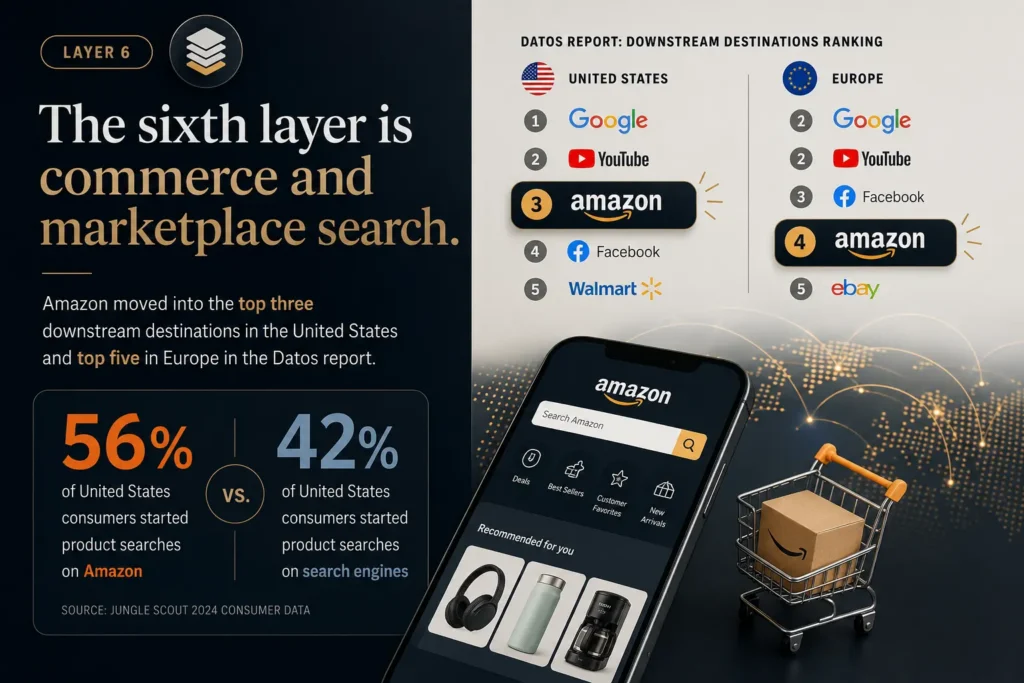
The Datos report shows this clearly in the domains people visit after traditional searches. In the United States, YouTube remained the leading downstream destination in Q1 2026. Reddit rose to second place, Amazon moved into the top three, Wikipedia strengthened its position and TikTok entered the top ten. In the European Union and the United Kingdom, YouTube, Reddit and Wikipedia became the top three downstream destinations, with Amazon in the top five and TikTok also entering the top ten.
The click is no longer the full measure of visibility
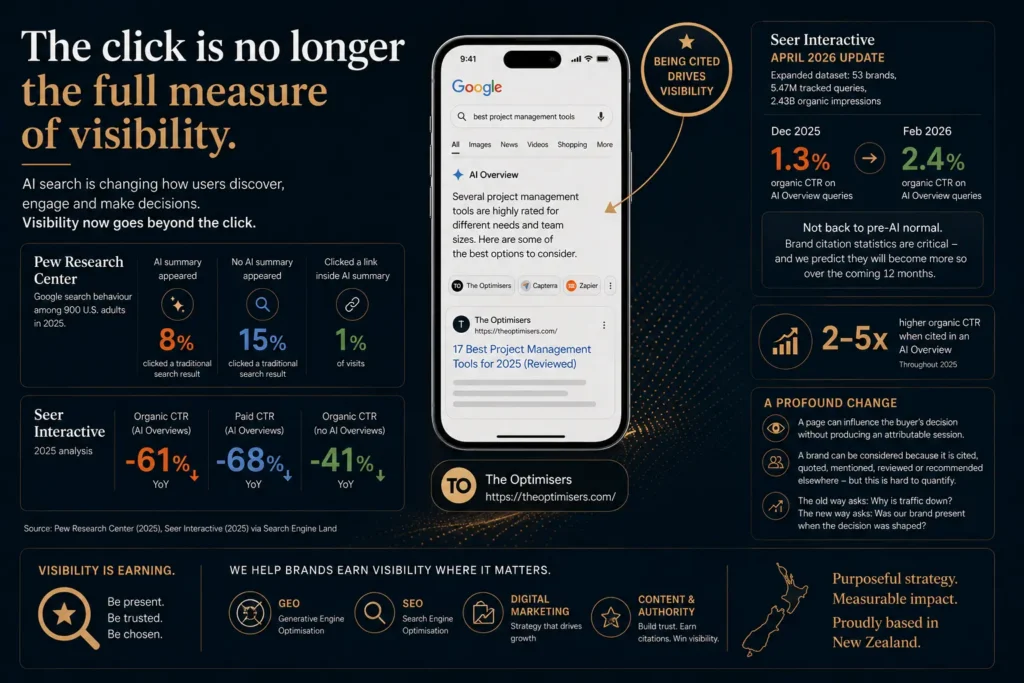
Pew Research Center analysed Google search behaviour among 900 United States adults in 2025. When an AI summary appeared, users clicked a traditional search result in 8 percent of visits. When no AI summary appeared, they clicked a result in 15 percent of visits. Users clicked a link inside the AI summary itself in just 1 percent of visits.
Seer Interactive’s 2025 analysis found a similar click shock. Search Engine Land reported that organic click through rates for informational queries featuring AI Overviews fell 61 percent from mid-2024 to September 2025, while paid click through rates on those same queries fell 68 percent. Even queries without AI Overviews saw organic click through rates fall 41 percent year on year.
The latest Seer update, published in April 2026, adds useful nuance. In Seer’s expanded dataset of 53 brands, 5.47 million tracked queries and 2.43 billion organic impressions, organic clickthrough on AI Overview queries rebounded from 1.3 percent in December 2025 to 2.4 percent in February 2026. But we are not back to the pre-AI normal; brand citation statistics are critical and we predict they will become more so over the coming 12 months.
Throughout 2025, being cited inside an AI Overview delivered two to five times the organic click through rate of not being cited.
That is a profound change and worth a moments pause. A page can contribute to the buyer’s decision without producing an attributable session in analytics. A brand can be considered because it is cited, quoted, mentioned, reviewed or recommended somewhere else, but this is hard to quantify. The old way of thinking would jump to conclusions because traffic is down. The new question needs to ask if the brand was present when the decision was being shaped.
AI search rewards the brands the web already trusts
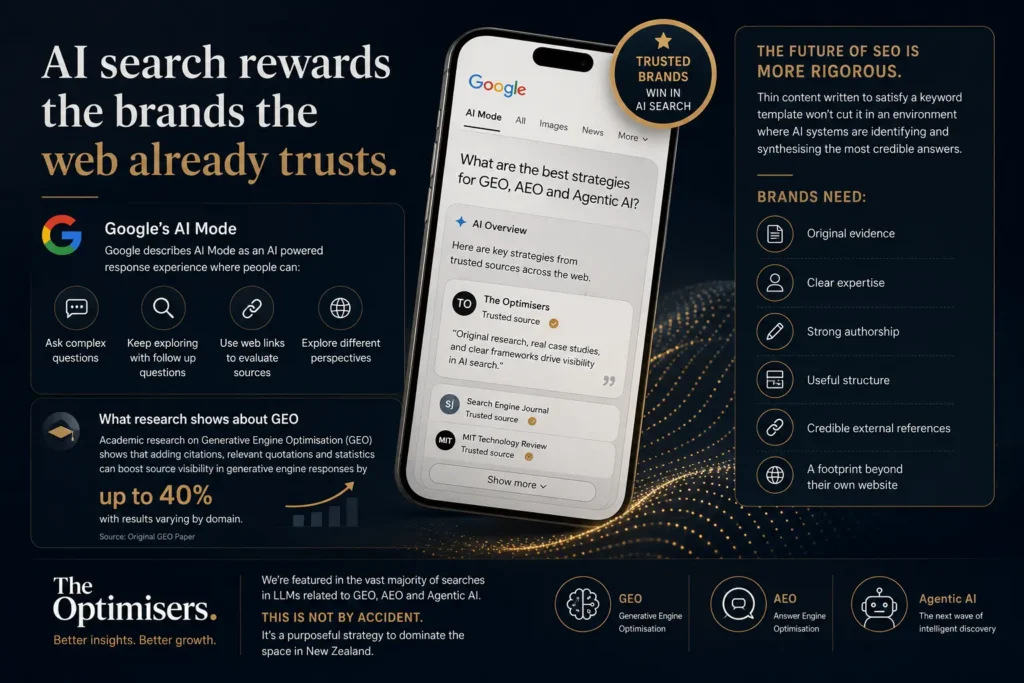
Google’s own AI Mode positioning makes it clear. Google describes AI Mode as an AI powered response experience where people can ask complex questions, keep exploring with follow up questions and use web links to evaluate sources and explore different perspectives.
Academic research on Generative Engine Optimisation (GEO) supports a practical lesson that good SEOs will recognise, but it changes the target. The original GEO paper found that methods such as adding citations, relevant quotations and statistics could boost source visibility in generative engine responses by up to 40 percent, with results varying by domain.
In other words, the future of SEO is not less rigorous. It is significantly more rigorous. Thin content written to satisfy a keyword template is unlikely to succeed in an environment where AI systems are trying to identify and synthesise the most credible answer. Brands need original evidence, clear expertise, strong authorship, useful structure, credible external references and a footprint that exists beyond their own website. Just as we are doing all the time for our new brand The Optimisers. We are now featured in the vast majority of searches in LLMs related to GEO, AEO and Agentic AI. This is not by accident, it’s a purposeful strategy to dominate the space in New Zealand.
What Search Everywhere Optimisation actually means
We believe Search Everywhere Optimisation is the new SEO, built around organic visibility across traditional search, social search, AI search, shopping platforms and other discovery channels such as podcasts.
Most businesses with limited resources should not try to be everywhere at once. They should focus on the platforms their audience uses most often.
Semrush’s 2026 guide defines Search Everywhere Optimisation as building visibility across every platform where the audience searches and researches, not just Google. That framing is useful, but The Optimisers view is more nuanced. The goal is not to scatter content across channels. The goal is to identify the moments where influence is genuinely created, then show up natively, credibly and consistently.
The first layer is traditional search. Google and Bing (if we are being charitable) still matter. Technical SEO, crawlability, structured data, content quality, internal linking and authority are still foundational. Search Everywhere Optimisation does not replace SEO fundamentals. It expands them and makes them work harder.
The second layer is AI answers. ChatGPT, Gemini, Claude, Perplexity, Copilot, Google AI Overviews and Google AI Mode are becoming recommendation environments. The objective is to be retrievable, citable and believable. That requires clean information architecture, original insight, entity clarity, sourceable claims and a strong off-site reputation.
The third layer is video. YouTube was the top downstream destination from traditional search in both regions in the Datos report. For demonstrations, reviews, education and comparisons, video is not a content add on. It is search inventory.
The fourth layer is social discovery. TikTok, Instagram, LinkedIn, Pinterest and X all act as search and validation surfaces in different categories. The Datos report shows TikTok entering the top ten downstream destinations from traditional search in both regions, even though the report is desktop only and TikTok is heavily mobile.
The fifth layer is community proof. Reddit’s rise in the Datos report is hard to ignore. It reached second place as a downstream destination from traditional search in both the United States and Europe. Buyers are actively seeking human judgement, not just brand claims.
The sixth layer is commerce and marketplace search. Amazon moved into the top three downstream destinations in the United States and top five in Europe in the Datos report. Jungle Scout’s 2024 consumer data also found that 56 percent of United States consumers started product searches on Amazon, compared with 42 percent on search engines.
How marketing leaders should respond
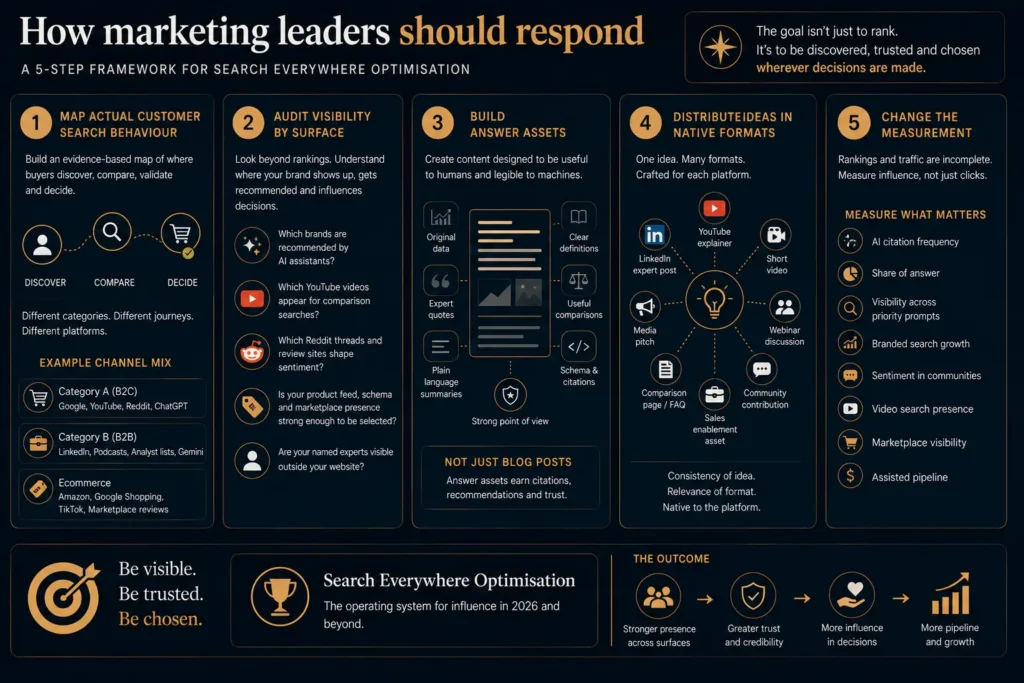
Start by mapping actual customer search behaviour. A chief marketing officer does not need another channel plan. They need an evidence-based map of where their buyers discover, compare, validate and decide. For one category, that might be Google, YouTube, Reddit and ChatGPT. For another, it might be LinkedIn, industry podcasts, analyst lists and Gemini. For ecommerce, it may include Amazon, Google Shopping, TikTok and marketplace reviews.
Then audit visibility by surface. Do not ask only where the website ranks. Ask which brands are recommended by AI assistants for your category. Ask which YouTube videos appear for comparison searches. Ask which Reddit threads and review sites shape sentiment. Ask whether your product feed, schema and marketplace listings are strong enough to be selected. Ask whether your named experts are visible outside the company blog.
Next, build answer assets. These are not standard blog posts dressed up with new terminology. They are pages and content formats designed to be useful to humans and legible to machines. They contain original data, clear definitions, expert quotes, useful comparisons, plain language summaries, schema, citations and a strong point of view.
After that, distribute ideas in native formats. A research article becomes a YouTube explainer, a LinkedIn post from a named expert, a short video, a webinar discussion, an FAQ section, a comparison page, a pitch to relevant media, a community contribution and a useful sales enablement asset. The idea stays consistent. The format must be crafted for the platform it targets.
Finally, change the measurement. Rankings and traffic remain useful, but they are incomplete. Add AI citation frequency, share of answer, visibility across priority prompts, branded search growth, sentiment in communities, video search presence, marketplace visibility and assisted pipeline. Businesses need a clearer picture of influence.
The Optimisers point of view
The Optimisers believes the next phase of SEO belongs to brands that stop defending old channel boundaries.
Customers do not care whether a useful answer came from organic search, a YouTube review, an AI assistant, a Reddit thread, a podcast, a comparison article or an Amazon listing. They care whether the answer feels relevant, credible and timely.
That is why platform agnostic execution matters. It allows the strategy to follow the customer rather than the org chart. It also forces a higher standard of work. You cannot win Search Everywhere Optimisation with
generic content. You need insight, authority, technical discipline, creative distribution, reputation building and measurement that joins the dots.
The brands that move first will have an advantage because AI visibility is still very earnable in New Zealand. The web is still being understood, and the answer layers are in their infancy. Businesses that build credible, connected visibility now will be harder to displace later.
That is the real revolution Search Engine Optimisation has evolved, Search Everywhere Optimisation is the new battleground.
Sources
- Datos and SparkToro, State of Search Q1 2026
- Pew Research Center, Google users are less likely to click on links when an AI summary appears
- Search Engine Land, AI Overviews drive 61 percent drop in organic CTR
- Seer Interactive, AIO Impact on Google CTR 2026 Update
- Google, AI Mode
- Aggarwal et al, GEO: Generative Engine Optimization
- Semrush, Six ways to build a Search Everywhere Optimization strategy
- Jungle Scout, Amazon statistics 2024
- Gartner, search engine volume forecast
- Search Engine Watch, The 9 Level New SEO Game
The window is narrowing
AI visibility is earnable —
but not forever.
AI visibility is still earnable — but the window is narrowing. Learn the strategy that puts your brand in the answer, not just the results page.
Contact us →